
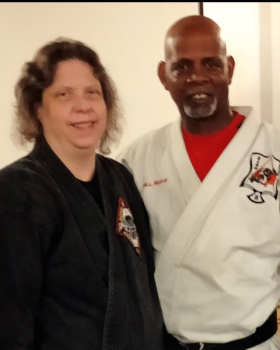
Today we would like to highlight 5th degree Blackbelt Mary Wright. Below is her bio of her amazing Kenpo journey.
“My kenpo journey began as a 10-year-old girl fascinated with sword fighting from the 1940’s swashbuckler movies. My parents found a karate school in Redding, California under Mr. Alan Myrtle and my folks asked me if I wanted to try it. I took the introductory course and fell in love with Kenpo. I clearly remember the look that Mr. Myrtle gave me when I told him that I wanted to go to black belt like so many people. It was not a look of negativity, or you’ll never get there; but it was a knowing look of how few persevere especially kids at that time. A few decades later, I feel very good about my Kenpo journey so far.
My early career in Kenpo as a junior girl was fun and exciting. I often assisted teaching with younger children in classes and was enthusiastic about learning more. I competed in local tournaments regularly winning junior forms and fighting. During this time, I had the pleasure of participating in two of Mr. Parker’s seminars. His movement was so powerfully dynamic, and his discussion of Kenpo principles encouraged and empowered me. To this day, I still cannot match his demonstration of power and precision within the stance changes of Triggered Salute.
Over the next few years, my Kenpo journey changed and I found a different instructor, Mr. Tom Ballard, who was a senior student of Mr. Jim Mitchell. I received my black belt with Mr. Mitchell as the head of the board. This was very special to me because I was the first person to receive a black belt at 16 in Mr. Mitchell’s organization. When Mr. Ballard had to move away, Mr. Mitchell accepted me as his direct student and I made several trips over the years to his school in Springfield, MO. During this time, I met and often worked with his son, Jerald Mitchell, who was teaching at his father’s school full time. I helped Mr. Mitchell with many projects including updating his written materials and occasionally helping in classes. We spent many hours going over the system and we often discussed the principles and concepts within the system. Some of the best discussions were about why, how, and when to make changes to the system to avoid random changes but to adapt in a logical, progressive manner. These discussions and detailed training directly helped my growing career in 911 dispatch.
911 dispatch is an emotionally challenging career requiring time, dedication, and intense mental focus. Most of the day is filled with inconsequential events broken up by sharing the worst day of someone’s life and sometimes your own. Kenpo’s focus on situational preparation and execution allowed me to succeed in that pressure filled environment for over 20 years. Through my conversations with Mr. Mitchell about his reorganization of the system and my Kenpo teaching experiences, I was able to develop updated training programs for dispatchers beginning this challenging lifestyle. The dispatch training system taught key basic knowledge, specific techniques based on situations, and free practice with another person before having to answer live calls. This system provided a stronger foundation and preparation for rookie dispatchers before handling live situations just as training in a studio should help prepare one for real conflict.
To mitigate the growing stresses of 911, I went back to two of my foundations: Kenpo and academia. Although I opened a part time Kenpo club in Salem, Oregon, the demands between 911 and college pushed Kenpo to the background. I was able to continue teaching privately as my schedule allowed. I also found a wonderful group of Kenpoists: the Society for Kenpo Studies. Mr. Milt Guinette introduced me to a network of outstanding martial artists throughout the Pacific Northwest. This allowed me to work on higher levels of Kenpo and exchange knowledge with fellow black belts. Through the Society, I developed friendships with Mr. A.c. Rainey, Mr. Todd Durgan, Mr. John Ellis and many others.”